


| 商品名称 | ZUTTA |
|---|---|
| 结构 |  |
| 说明 | ZUTTA是一种自主牵引机器人,能够通过跟踪人物来牵引负载。 |
| 长度 | 约58cm |
| 宽度 | Approx.57cm |
| 高度 | 约52cm |
| 最大速度 | 6km/h (when towing 600 kg) |
| 电池 | Sealed Lead Acid 24V, 72Ah |
| 充电器 | 输入:AC 100V 输出:24V,25A(最大) |
| 充电时长 | 5小时~8小时 |
| 定位精度 | ±200 mm |
| 连续运行时间 | Approximately 8 hours (when 600kg traction is set) |
| LiDAR | 30m / 360° |
| Title of Invention | Moving Body, Control Method for Moving Body, and Program |
| Filing / Registration | Filed on April 28, 2022 (Accelerated Examination) / Registered on October 4, 2022 (Claim 7) |
| Claim Type | Device (Moving Body) + Control Method + Program |
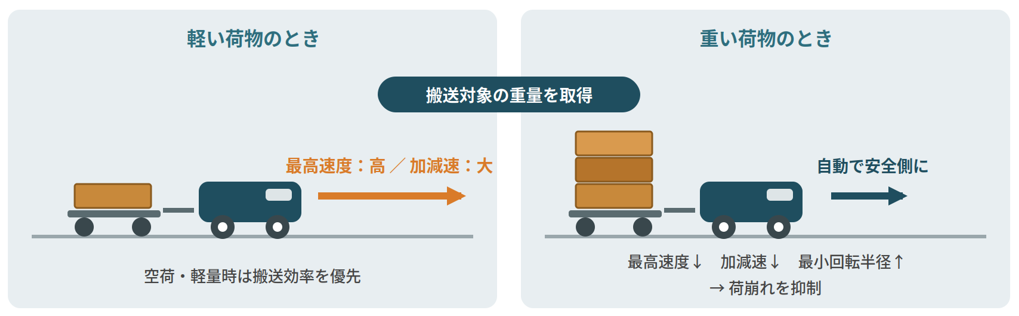
Figure 1: Concept of load collapse suppression control according to load weight
This patent protects a moving body that acquires the weight of a transport object and controls the movement mechanism to suppress load collapse according to the weight. The independent claim is written with a concise structure consisting of an acquisition unit for acquiring weight and a control unit for controlling a movement weight-linked load collapse suppression control. The dependent claims individually cover three specific control parameters that are practically essential for implementation: control to lower the maximum speed as the weight increases, control to lower the maximum absolute value of acceleration/deceleration, and control to increase the minimum turning radius. Additionally, the form of towing a transport cart (towing-type AMR) is also explicitly covered.
The prior art cited is a forklift that decelerates according to road surface conditions, and this patent has novelty in using the load weight as a control input, based on the insight that even if the road surface is good, if the load is heavy, load collapse will occur. For AMRs that perform variable loading and towing operations, the motivation to implement this type of weight-linked control for safety is extremely strong, making it a claim that is practically difficult to circumvent.
| Title of Invention | Moving Body, and Program |
| Filing / Registration | Filed on May 12, 2022 / Registered on April 30, 2024 (Claim 5). Established by a patent decision after an appeal against a decision of refusal (Appeal 2023-18840). |
| Claim Type | Device (Moving Body) + Program |
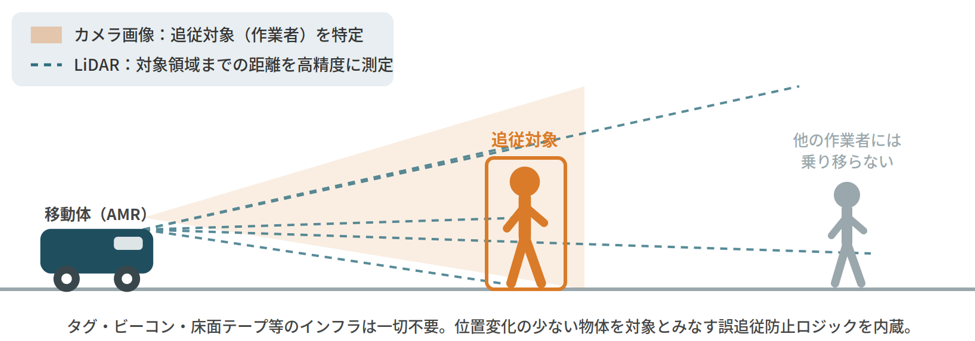
Figure 2: Identification of Following Target by Camera x LiDAR Fusion
This patent covers perception technology, which is the core of person-following AMRs. It protects the division of roles between a camera and LiDAR, where a following target (worker) is identified from an image captured by an image sensor (camera), and the measurement results of a distance measuring sensor (such as LiDAR) corresponding to the area identified on the image are used to determine the position of the following target in a local coordinate system. This following method requires absolutely no infrastructure such as tags or beacons, using the camera’s recognition ability to decide who to follow and the LiDAR’s precision to measure where they are.
Furthermore, it includes a determination logic that treats an object whose position change in the local coordinate system during movement is smaller than other objects as the following target, embedding a countermeasure against mis-following (switching to another person in a crowded environment) into the constituent elements.
The dependent claims expand the technology to include: storing the latest position of the following target and moving to the latest position if lost (Claim 2), moving along a path matching the recent position history (Claim 3), and acquiring the size of the transported item using a sensor and perform obstacle avoidance considering the protrusion of the load (Claim 4). This patent was established through an appeal, and the fact that it is a right obtained after a decision by a panel of the Patent Office is highly evaluated from the standpoint of stability. On the other hand, during that process, limitations such as the aforementioned determination logic were introduced into the claims, so the scope of rights is aligned with this specific configuration (this point will be supplemented in Chapter 4).
| Title of Invention | Moving Body, and Program |
| Filing / Registration | Filed on November 10, 2023 (Accelerated Examination) / Registered on March 12, 2025 (Claim 2) |
| Claim Type | Device (Moving Body) + Program |
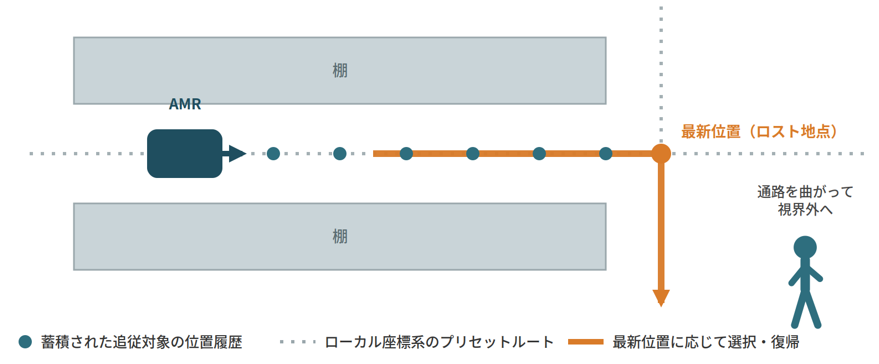
Figure 3: Preset route recovery when losing sight of the following target (Top view)
This patent addresses loss (losing sight) of the target, which is the biggest operational issue in following operations. It assumes a hybrid following method that balances computational load and robustness by identifying the following target with a combination of camera + LiDAR at the start of movement, and continuing tracking using only the LiDAR measurement results during movement. On this basis, the configuration requires accumulating the latest positions of the following target in a storage unit. If the position can no longer be identified, it selects a route from among multiple pre-set routes in the local coordinate system based on the latest position of the following target and moves along it as a recovery action.
In an environment where the lines of movement are determined to some extent, such as a warehouse aisle, this technology algorithmizes the operational insight that if a worker disappears behind a shelf, you can rediscover them by proceeding along the aisle in that direction. This eliminates typical operational losses of following-type AMRs, such as stopping on the spot when lost and waiting for a worker to retrieve them. The specification is thick at 29 pages, with extensive descriptions of embodiments, providing substantial depth in terms of potential future amendments or corrections.
| Title of Invention | Wheel Drive Device |
| Filing / Registration | Filed on December 22, 2023 (Accelerated Examination) / Registered on September 11, 2024 (Claim 5) |
| Claim Type | Device (Wheel Drive Device) |
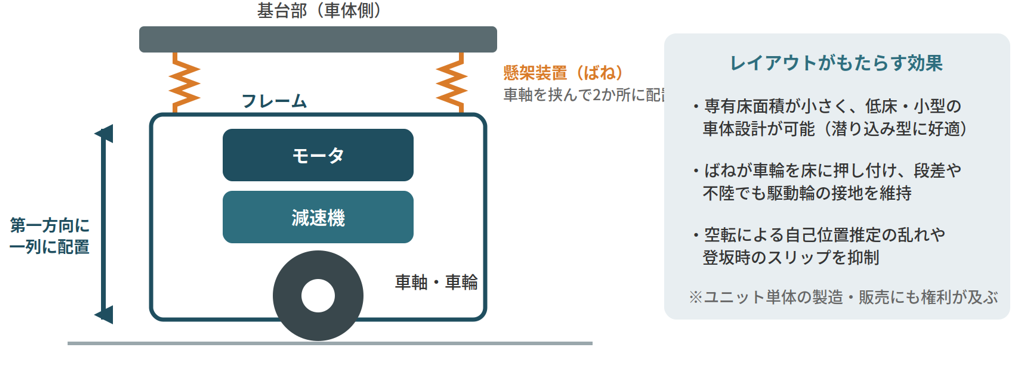
Figure 4: Wheel drive device with integrated suspension and vertical in-line layout (Schematic side view)
This is the only hardware patent in the portfolio, protecting the drive unit that constitutes the undercarriage of the AMR. The independent claim covers a layout where the motor, a reduction gear whose input and output shafts are parallel to the motor shaft, and the axle are aligned in a row along a first direction perpendicular to the motor shaft (typically the vertical direction) and held in a frame. This captures an arrangement that minimizes the floor space occupied by the drive unit, enabling a more compact and low-profile vehicle body design.
The dependent claims progressively protect a configuration that integrates a suspension system supporting the base part into this frame, an arrangement placing the spring further from the base part than the axle, a configuration arranging two or more suspension systems to sandwich the axle, a linear guide structure guiding the approach and separation of the frame and base part, and a clamping/compression structure for the spring. This directly protects the design of a compact drive unit with a built-in suspension, which maintains drive wheel contact on uneven floors, preventing loss of self-position estimation due to slippage or spinning. Unlike software patents, this right extends to the manufacture, sale, and import of individual units, giving it a different type of strength for protection against imitation products.
| Title of Invention | Moving Body, and Program |
| Filing / Registration | Filed on May 13, 2024 (Priority date: May 10, 2024, Accelerated Examination) / Registered on March 12, 2025 (Claim 6) |
| Claim Type | Device (Moving Body) + Program (Two systems of independent claims) |
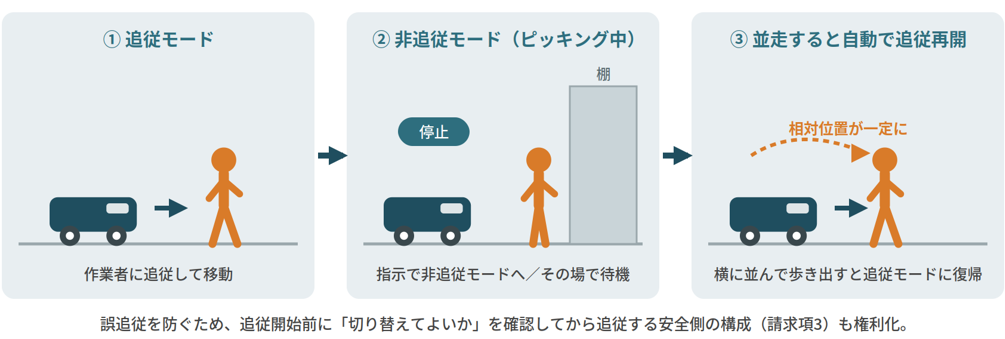
Figure 5: Following/Non-following mode switching and automatic re-following by walking alongside
This patent protects the interface used when integrating following-type AMRs into actual work workflows. Assuming a moving body with a following mode and a non-following mode (pre-determined behavior), it includes two independent inventions. First, a configuration where, while moving in non-following mode, if the relative positional relationship between the detected following target and the moving body becomes constant, it automatically returns to following mode (Claim 1). If a worker stands next to the robot and starts walking together, tracking resumes without any button operation, a specification that is extremely natural for on-site actions. Second, a configuration where, when a following target is detected during non-following mode, information confirming whether it is acceptable to switch to following mode is output, and the switch is made only after receiving acceptance (Claim 3), a safe design that prevents starting to follow the wrong person.
The specification illustrates a scenario where the moving body is temporarily stopped during picking work in a warehouse, covering the basic operation itself of a following-type picking cart: follow → stop for picking → follow again. This is a new right registered approximately 10 months after filing, and it has the longest remaining duration (until May 2044).
| Title of Invention | Monitoring Device, Monitoring Method, and Program |
| Filing / Registration | Filed on November 13, 2019 (Accelerated Examination) / Registered on July 31, 2020 (Claim 14) |
| Claim Type | Device (Monitoring Device) + Monitoring Method + Program. Jointly owned by Mr. Hisanori Date and KeisuuGiken |
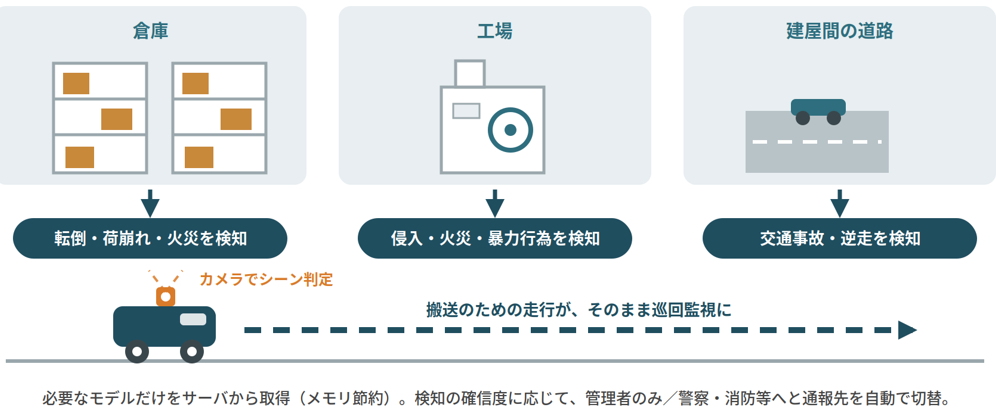
Figure 6: Automatic switching to the optimal anomaly detection AI by scene determination (Image when mounted on an AMR)
This patent is not for the AMR itself, but protects the basic configuration of scene-adaptive AI surveillance: using AI to determine what is currently being filmed (type of monitored target = scene) from camera footage, applying the captured images to a monitoring model corresponding to the determined type to detect anomalies, and outputting notifications upon detection. The dependent claims systematically expand to include: a configuration to retrieve only the model corresponding to the determination result from multiple models held on a server (saving memory and computational resources on the device side), a configuration to use multiple models simultaneously when multiple types of monitored targets are included in an image, a configuration to apply respective models to image regions for each type to increase accuracy, a configuration to change the notification destination depending on the confidence level of detection (low confidence to managers only, high confidence to public institutions like police or fire departments), and even detection combining audio.
What is important in the context of AMR licensing is that the specification explicitly mentions use with cameras mounted on moving bodies such as automobiles, drones, and surveillance robots, describing operations where scene determination is repeated during movement. In other words, by combining this patent with the AMRs in this portfolio, it is possible to realize an advanced functionality as a moving surveillance camera that automatically switches to the optimal anomaly detection AI (fall/load collapse, fire/intrusion, traffic accidents, etc.) every time the driving scene changes between a warehouse, a factory, and a road between buildings, backed by patent rights. This adds a second value of patrol surveillance and safety oversight on top of the original transport value of the AMR, acting as an upsell element. It can also be expanded horizontally to fixed surveillance camera systems, serving as an expansion axis for the portfolio.
4. Strength of Patents through Combination
■ 4.1 Multi-Layer Defense Penetrating Technical Hierarchies Vertically
The greatest value of this portfolio lies not in the breadth of individual patents, but in the fact that it protects a single product category—following-type AMRs—by layering protection across technical hierarchies. If a competitor attempts to develop a similar person-following transport robot, they will face different patents at each stage of development: camera-LiDAR fusion for target identification in the perception layer (7481029), route recovery when lost (7649571) and mode switching/automatic re-following tailored to workflows (7649580) in the operational layer, weight-linked speed/acceleration/turning control in the safety layer (7152821), and a vertically aligned compact drive unit with built-in suspension in the hardware layer (7554441). Furthermore, if they attempt to expand into an AMR with monitoring functions, scene-adaptive AI surveillance (6742623) adds an obstacle at the advanced functionality layer. Even if one patent can be avoided, the remaining ones function as barriers, making the design-around cost for the product as a whole significantly higher than the simple sum of 6 individual patents.
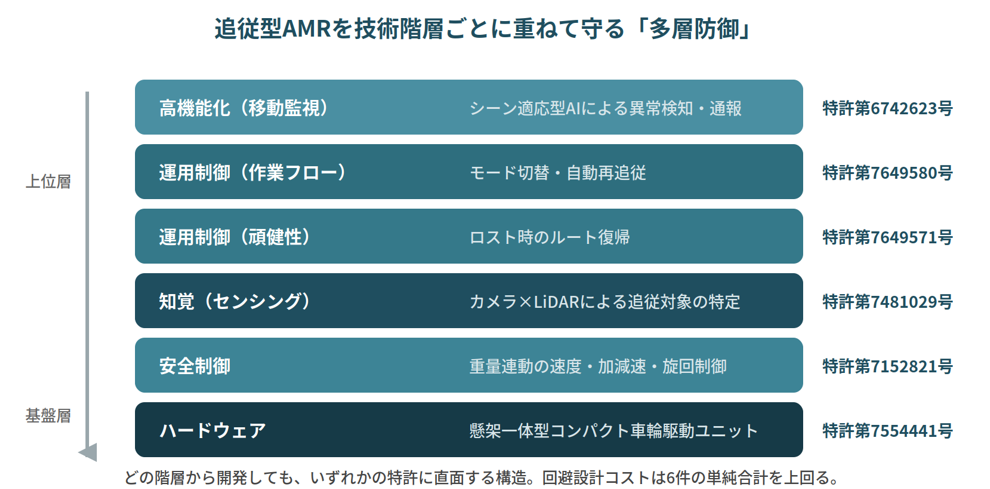
Figure 7: Structure of multi-layer defense by technical hierarchy
■ 4.2 Claim Network of Devices, Methods, and Programs
All 5 software-related patents feature program claims, and 7152821 and 6742623 also include method claims. As a result, the rights directly cover not only the act of manufacturing and selling the robot body, but also the acts of manufacturing, transferring, and distributing control software, as well as retrofitting software to existing AMRs. In the AMR industry, where OEM supply of vehicle bodies and separate sales/updates of software are common, the existence of program claims provides enforcement power tailored to the realities of the business model.